

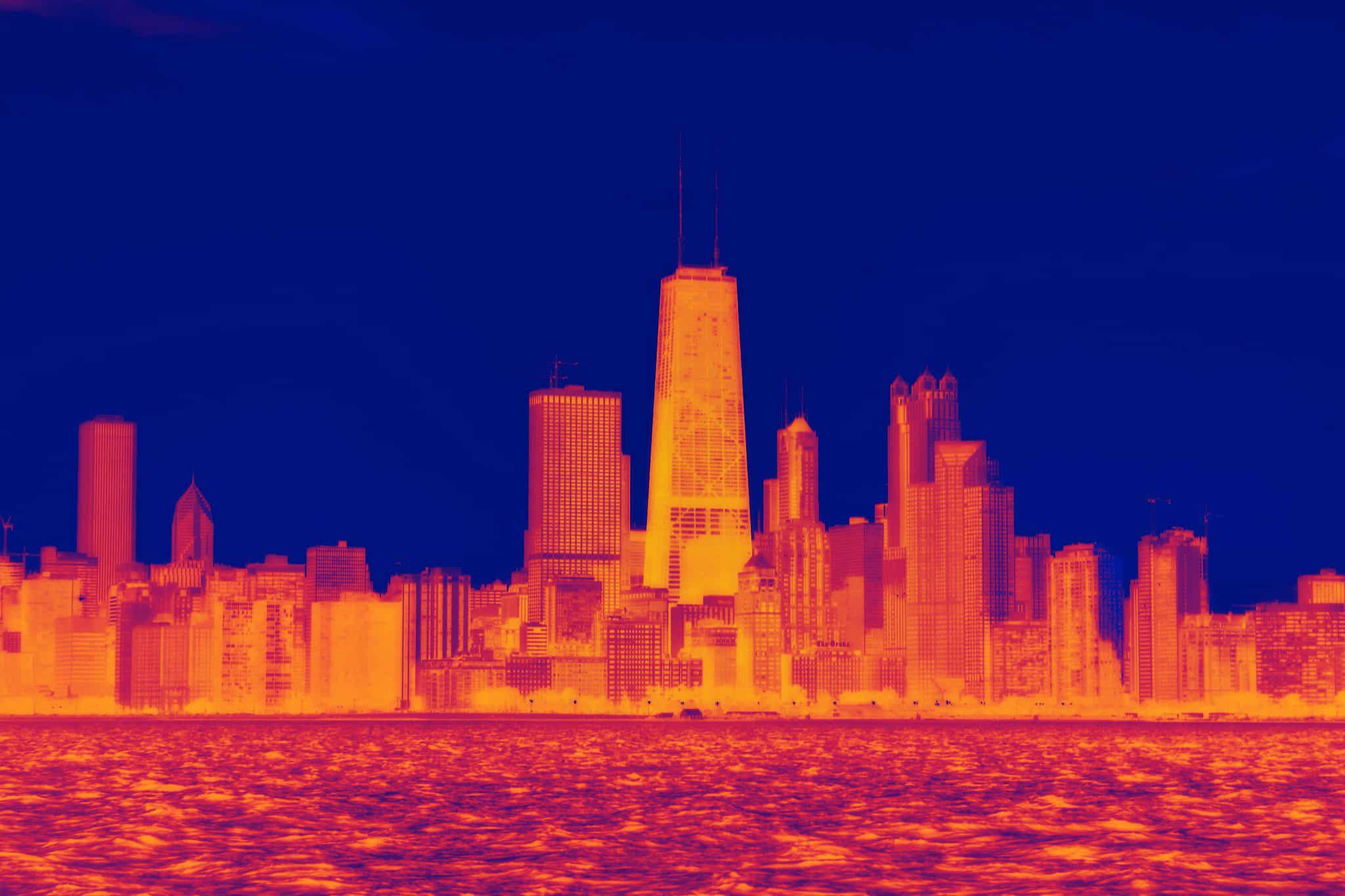
Cities are islands of heat. The materials and activities that make modern urban life possible — especially concrete, asphalt and concentrated energy use — trap and emit heat at the surface.
That “urban heat island” (UHI) warms not only the air but also the shallow ground. Recent geophysical work shows that temperature changes in the near-surface crust create measurable thermo-elastic stresses and pore-pressure effects that can alter fault stability.
While large, tectonically-driven earthquakes are not suddenly created by pavement and buildings, the combination of subsurface warming, anthropogenic loading and other human actions can change when and where small-to-moderate seismicity occurs — and, in some settings, may modulate the timing of larger events.
From concrete slabs to a warmed subsurface
Concrete is central to the built environment: roads, foundations, bridges and high-density building faces. Compared with vegetated surfaces, concrete and asphalt have high specific heat capacity and low evaporative cooling, so they absorb solar energy during the day and release it slowly at night.
The surface and near-surface temperature contrasts produced by dense built surfaces are a major driver of urban heat islands. Urban climatology reviews and measurements show mean air-temperature increases of several degrees Celsius in many cities; surface temperature differences can be far larger.
Concrete’s thermal behaviour — storage, slow release and radiation — is a key factor in this amplification.
Crucially, heat does not stop at the pavement. Recent work highlights significant below-ground warming beneath cities: soil and shallow bedrock layers beneath heavily built areas are measurably warmer than surrounding rural ground, and this warming can penetrate meters to tens of meters depending on thermal conductivity, building subsurface infrastructure and long-term anthropogenic heat flux.
In other words, UHIs have a significant subsurface component — triggering an “underground climate change”.
How temperature alters stresses on faults
Rocks expand when heated and contract when cooled; this thermo-elastic response produces thermo-mechanical stresses. Within the upper crust these temperature-driven stresses add to the background tectonic stress field.
The magnitude and geometry of the induced stresses depend on the amplitude of the temperature change, the spatial gradient (how rapidly temperature changes with depth or laterally) and the mechanical properties of the rocks and faults.
Thermo-elastic modelling and laboratory experiments demonstrate that realistic surface temperature anomalies can produce non-negligible stress perturbations in the upper few kilometres of crust — the same depth range where many shallow, human-felt earthquakes originate.
Thermal perturbations can affect fault stability in two main ways:
1. Direct thermo-elastic stressing: Differential expansion of rock masses changes the normal and shear stress on pre-existing faults. A small increase in shear stress or a decrease in effective normal stress (making a fault “closer to failure”) can raise the probability of slip on a critically stressed fault.
2. Thermo-hydraulic coupling: Heating can change pore pressures (through thermal expansion of fluids and changes in permeability) and altered pore pressure changes the effective normal stress directly. Many types of induced seismicity (for example around geothermal operations or fluid injection) are understood through coupled thermal-hydraulic-mechanical processes.
What the observations and models say — limits and realities
There are important practical limits to these mechanisms. First, the magnitude of thermo-elastic stress from surface warming is small compared with the long-term tectonic stresses that drive plate motions.
Thus, thermal warming from buildings and pavement is unlikely to trigger a massive earthquake of significant intensity from scratch. Second, the depth penetration of surface warming is limited: seasonal and anthropogenic heat fluxes most strongly affect the shallow crust (metres to hundreds of metres), whereas the nucleation zones of the largest earthquakes (focii) often lie deeper (kilometres).
These two constraints mean that thermal forcing is most likely to influence small to moderate, shallow seismicity, or to change the timing of failure on faults that are already near critical state, rather than to initiate major tectonic ruptures by itself.
Empirical and modelling studies support a nuanced picture. Statistical analyses have reported correlations between regional temperature anomalies and changes in low-magnitude seismicity, and numerical thermo-poro-elastic models reproduce fault reactivation under thermal loading in settings such as geothermal fields.
There are also well-documented cases where cooling (for example from injection of cold fluids) or heating associated with energy operations induced seismicity by altering stresses and pore pressure.
These analogues indicate that human thermal activity can change seismic hazard locally in specific hydrogeological and tectonic contexts.
Urban heat islands, concrete and earthquake frequency/intensity — synthesis
Concrete and UHI create persistent near-surface warming. This raises shallow ground temperatures and modifies thermal gradients beneath cities. Shallow thermal perturbations change local stress concentration and pore-pressure fields.
If faults at shallow depths are already near failure, even modest thermo-elastic or thermo-hydraulic changes can tip the balance and trigger small events, or advance the timing of slip. Net effect on earthquake frequency and intensity is context-dependent.
In many cities the effect is likely subtle — an increase in shallow microseismicity or more frequent low-magnitude events — rather than a wholesale increase in large earthquakes. But in tectonically sensitive urban corridors, such as coastal, reservoir-affected (sizeable hydroseismicity), geothermal or heavily fractured rock under high anthropogenic heat flux, the combination of UHI warming, subsurface infrastructure, fluid use and loading could measurably affect seismic hazard.
Policy, planning and research priorities
Given the plausible linkages and the high societal stakes of urban seismic risk, cities should treat underground climate change as an element of resilience planning.
This should include mapping subsurface thermal anomalies. Urban planners and geoscientists should, therefore, measure and model shallow ground temperature fields beneath major urban centers to identify hotspots and vulnerable infrastructure.
Also, thermal effects should be integrated into urban seismic hazard assessments. For cities near active faults, thermo-poro-elastic scenarios (especially where shallow faults exist or where geothermal/fluid activities occur) need to be projected.
Mitigation of UHI can additionally be achieved through urban afforestation and Miyawaki Urban Forest creation and the reduction of anthropogenic heat flux by using heat pumps with enhanced coefficient of performance.
Classic UHI solutions (more vegetation, cool pavements and roofs, reduced waste heat, utilizing strategies to reuse waste heat), lower surface and subsurface temperatures and deliver co-benefits for health and energy use. Reducing heat at source also reduces any thermo-elastic nudges to faults.
Finally, monitoring induced and shallow seismicity near high-heat urban projects along with Underwater Domain Awareness near marine areas and large freshwater sources like lakes is also essential.
Geothermal wells, deep basements, large subsurface thermal storage, Thermal Energy Storage Systems and dense underground networks should include seismic and thermal monitoring and adaptive management.
“Underground climate change” — the warming of the shallow crust caused by concrete, concentrated energy use and urban heat islands — is real and measurable.
Geomechanical theory, laboratory work and case studies of induced seismicity show that thermal and thermally coupled processes can alter stresses and pore pressures in the upper crust.
The honest scientific verdict is balanced: concrete-driven warming is unlikely to directly cause major tectonic earthquakes, but it can modulate shallow seismic behaviour and the timing of slips on faults already near criticality, particularly where other anthropogenic factors (fluid use, subsurface construction) are present.
For cities built near active faults, these findings argue for including subsurface thermal dynamics in hazard assessment and for pursuing UHI mitigation as a risk-reduction measure with multiple benefits.
COP 30, which was held in Belém, Brazil, from the 10th to the 21st of last month, could have facilitated this by raising awareness of the issues and promoting underground climate change reduction strategies, but considering it failed to highlight many of the more critical problems related to climate change, this is not at all surprising.



COP 30 was a minacious charade

Rivers of the air: How atmospheric rivers shape weather, water and climate
Earth's weather-makers: The climate engines driving global drought
The hidden war on honeybees: Murder hornets, parasitic wasps and the fight for survival

4 Ways to Use Carbon Dioxide to Curb Global Warming

Is UK's North Sea Drilling Plan a Sustainable Solution? An Impact Assessment Report