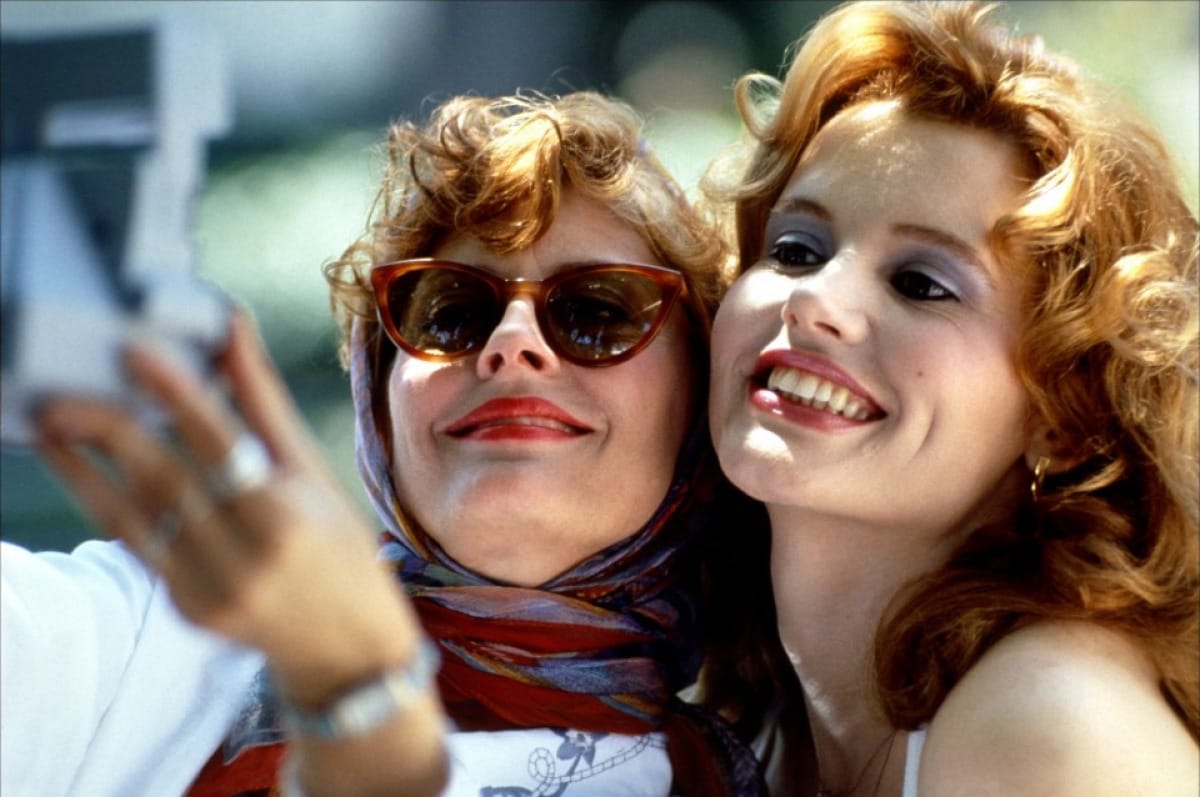
Behold the famous and iconic final scene of Thelma & Louise: by the time they literally reach “the end of the road,” these two women, whose beauty seems to grow as their rebellion unfolds and whom we watch with increasing admiration, have nowhere left to go. Behind them lie the men of “the law,” who have cornered them with no way out; the only path open to them is the cliff that stretches out in front of them. Louise gives the signal, and these women, who can communicate with a single glance, silently come to an agreement in that moment and choose “freedom.” That is, death. What makes this finale unforgettable is the trick of ending not by showing their car tumbling down the cliff, but by freezing them mid-air in their flight toward freedom. With this frame—by virtue of film language—Thelma and Louise do not die; they are, in fact, “immortalized.” As seductive as this celebratory reading of the finale is, a mind under the spell of Thelma and Louise’s rebellious spirit can’t help but ask: Why did freedom have to be synonymous with death for these women? With that final frame that insists “Thelma and Louise are immortal,” why does the film “martyr” these women?
There is a detail the summary above leaves out: At the very moment when Thelma and Louise choose death rather than return to the menacing male universe waiting behind them—to the yoke of husbands, cops, the law, harassers, rapists—just before they soar toward death, they kiss. For the first and last time. Why at that moment, and not earlier? Are these women—who, from the very beginning of the film, never trust any man the way they trust each other, who would risk anything for one another, who dream of a shared future—only “realizing” at that point that they are in love? Or is it that the film, which has only been able to present their love story covertly up until that point, dares to make it explicit only at the very moment it kills them off? The minute the question arises— “Oh, so they’re not just friends, comrades, sisters?”—the minute lesbian love becomes explicit, they die. In this way, within heteronormative mainstream cinema, the film manages to establish a recordbreakingly short distance between the tension generated by homoeroticism and the relief that comes from dispelling that tension. Viewed from this angle, that famous frame that shows Thelma and Louise’s car suspended in mid-air becomes a postcard of the limits of mainstream cinema. The Dead End of the Happy Ending.
Now let’s jump from two women who only dare to unite by choosing death, to the story of two other women who, once they realize they could unite, choose death. A far less known film than Thelma & Louise, the 1961 production The Children’s Hour is in one sense more conservative, but in another sense perhaps more daring. This is director William Wyler’s second adaptation of the same stage play. He first adapted Lillian Hellman’s 1934 play in 1936 under the title These Three. But in an era when the harsh censorship mechanism of the Hays Code is in full force—years in which the presence of a homosexual character or relationship in a Hollywood production is explicitly forbidden—Wyler brings this first adaptation to the screen by completely eliminating the theme of lesbian love that lies at the very center of the original text. That clearly doesn’t sit well with him, because in 1961 he adapts the same play once again. Karen, played by Audrey Hepburn, and Martha, played by Shirley MacLaine, are two teachers who own a girls’ boarding school. They themselves live inside the school. Just as we’re given the information that they have been friends for many years before founding the school, we also begin to sense that there is “something odd” about this friendship. Early in the film they’re sitting in the kitchen reminiscing about their university days, when Martha, as if lost in her memories, says in a dreamy tone, “The first time I ever saw you at school you were running and your hair was flying in the wind. I remember thinking to myself: ‘What a beautiful girl.’” From that moment on, the film keeps gently suggesting the possibility that Martha is in love with her best friend. That feeling grows stronger with Martha’s obvious jealousy of Karen’s fiancé Joe, her brusque behavior toward him, and the small nervous breakdown she has when Karen’s possible marriage is being discussed. During an argument between Martha and her aunt, the aunt’s words finally voice, in very clear terms, both Martha’s lesbianism and her love for Karen: “You can’t bear the thought of them being together, so you take it out on me. What will you do when they’re married? Always jealousy, jealousy. You were like this as a child too. If your girlfriends showed interest in anyone else, you would get jealous. This behavior of yours is utterly abnormal, against nature.”
The film’s villain is one of the students at the school, Mary—a girl portrayed as a full-on “little devil.” Mary spreads the lie that her teachers Karen and Martha are in a lesbian relationship. This “slander” grows; eventually everyone pulls their children out of the school, the lesbianism rumor spreads everywhere, the lawsuit they file is decided against them, they become front-page headlines across the country, and the two women end up trapped inside the school building, unable to step outside, left utterly alone and helpless. In the final part of the film, Martha’s moment of realization and her explicit articulation of her lesbian identity take the film to a historic place: The Children’s Hour becomes the first Hollywood film to depict a homosexual character, breaking through the Hays Code prohibitions.
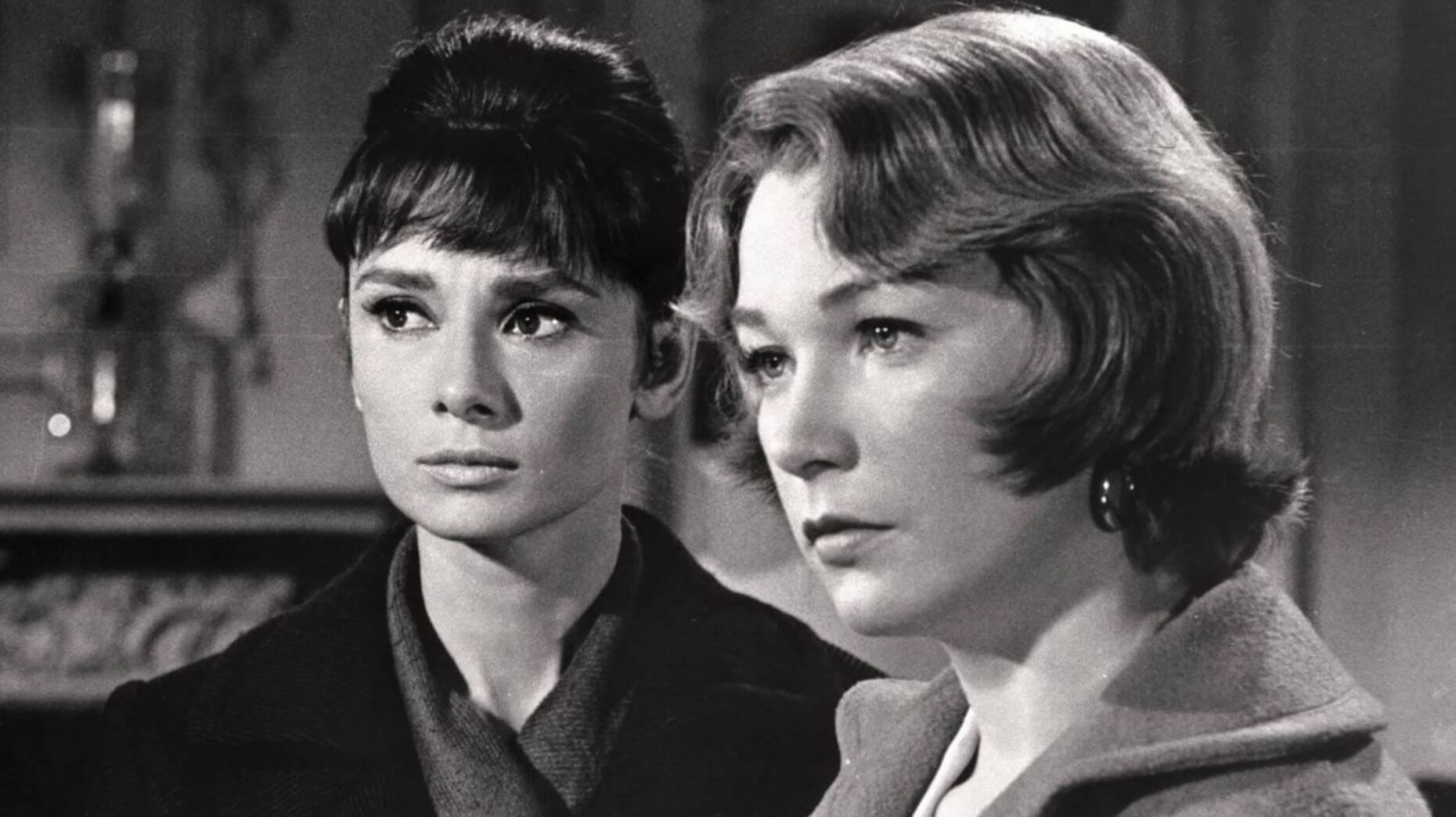
In the film’s most striking scene, Karen and Martha stand at opposite ends of the frame as they talk. Karen is in the foreground, facing us; Martha sits in the background on a chair, her face turned away from Karen. This is the first time they are about to say things they cannot say while looking into each other’s faces. Karen says, “But this sin they accuse us of isn’t being committed for the first time. Other people’s lives aren’t being ruined because of it?” Martha responds, “But those people believe in this, they want it. They choose it for themselves consciously. We’re not like that. It must be very different for them. We’re not in love with each other,” and then, suddenly unable to stop herself, launches into an endless monologue about how “normal,” how “natural” her friendly love for Karen really is. As her speech slips into a kind of rambling, Martha hovers on the brink of a nervous breakdown. Just as we realize these words are being spoken to deny a truth, to convince herself of a lie, Karen ends the monologue with one well-aimed question: “Why are you saying all this now?” With that question we cut to a close-up of Martha. The moment of great confession is coming. Martha still cannot look at Karen, nor can she show her face to us: “Because I love you. I love you the way they say,” she shouts, and begins to cry. In the new shot that follows these words, the distance between the two women widens even more; the frame manages to create, within the same room, a distance across which they will never be able to reach each other. The film’s conservatism can be seen—indeed, demonstrated—purely through the framing choices in this scene.
Immediately after this powerful “confession” scene, everything is suddenly resolved. It’s revealed that the little girl lied; her grandmother comes and apologizes to Karen and Martha. She tells them the court decision will be overturned, that corrections will be printed in the newspapers. They are “cleared,” free to go wherever they want and build a new life. Karen suggests exactly that. Now that she knows her friend is in love with her, she invites Martha to build a new life together. A happy ending… that could have been. But the film ends with Martha’s suicide. What the film does is this: it first forces them to experience what would happen if they truly were a lesbian couple, and then says, “Here you are, a happy ending, now you can be that couple.” What else is Martha supposed to do but kill herself? The same cliff that lies before Thelma and Louise appears in front of Martha and Karen in the form of the possibility of a happy ending. Everything they have gone through over the course of the film makes it clear that this happy ending is a dead-end road, a fatal precipice.
For none of these women is it possible to seize life; at the very moment they discover themselves and their love, if they are to lay claim to that love, they must choose death. Those who unite only through death; those who die the moment they perceive the possibility of union. Those who pass the threshold of death as if passing beneath a rainbow. Women whose bad fate is woven into the very narratives of mainstream cinema; subtextual loves like Martha and Karen, Thelma and Louise and many other female pairs that might come to mind.
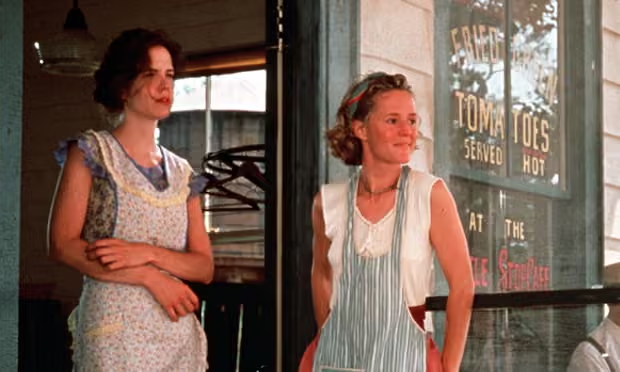
Idgie and Ruth in Fried Green Tomatoes or Celie and Shug in The Color Purple, for example. Lesbian desire and love, buried within the narrative of “women’s friendship”: in some cases repressed down into the deepest layers, in others closer to the surface. In The Color Purple—as in Thelma & Louise— this desire may flash up in a single kiss, like a burst of light from a camera flash, or in Fried Green Tomatoes it may appear only in the way Idgie and Ruth look at each other as they talk together in the dusk after swimming in the lake. Buried just enough that those who wish to can ignore it, forget it later when they recall the film. Yet blatant enough that those who want to see it—those who stubbornly look for it—can do so. Women who love each other from afar while pressed close side by side, who are always together yet never allowed to unite. Women whose desire, because of censorship and mechanisms of self-censorship, is buried in the subtext of the film, never allowed to unite on the level of the film text. Some feminist film scholars and theorists propose that we dig into these subtexts, bring them to the surface; that we take the subtexts of films and, through readings that go beyond the film’s own intentions, reconstruct their meanings. To wrest films from the hands of their makers, to free them from their own limits, in a sense. Why not? Can the loves of women who, on the visible surface of the film, can only be friends—yet whose loves are buried in barely discernible layers beneath that surface—be liberated through film readings? Can viewers (in their minds) finally bring these women together? Might a form of freedom other than death become possible for them in this way?